 By Sumanta
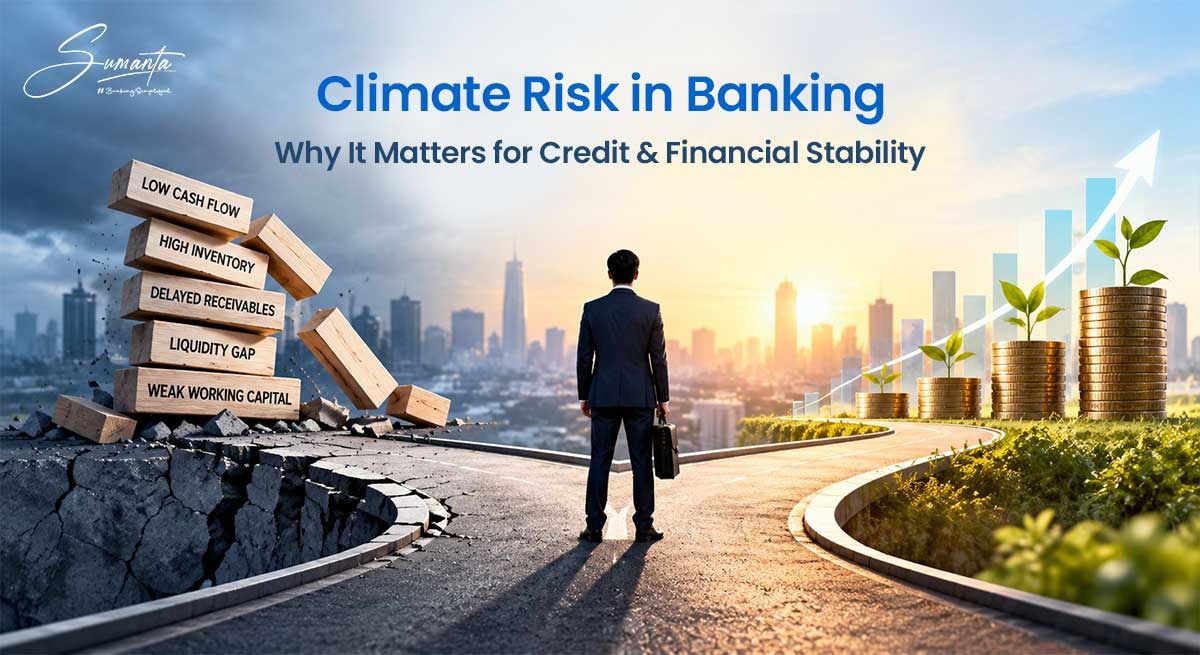
Climate Risk in Banking: Why It Matters for Credit & Financial Stability
Most of us check the weather forecast before a long drive. A few minutes of checking can save a ruined trip. Credit appraisal now needs the same habit. But before we talk about how, we need to answer a more basic question: which loan book are we even talking about?
That is where this overlay becomes important. It does not mean the same thing for a ₹200 crore corporate exposure and a ₹35 lakh home loan. Conflating the two is where many discussions on this subject go wrong.
Why This Splits Into Two Very Different Stories
In corporate lending, things have moved to a large extent. In retail, as of today, they largely have not. A credit professional structuring a large exposure and one sanctioning a home loan are working with completely different tools, different data, and of course, different regulatory pressure.
The objective, however, is the same: understand whether climate-related events could affect the borrower’s ability to repay.
In Corporate Credit: Already Structured
For large corporate exposures, climate risk management in banking increasingly involves ESG assessment, Climate risk rating along with Internal Rating, scenario analysis and stress testing. Sustainability-linked loans connect lending terms to a borrower’s sustainability targets, while transition finance can support cleaner technology in sectors such as steel and cement.
Consider an industrial borrower whose factory is located in a flood-prone area. Its financial statements may look healthy, but a major flood could damage machinery, interrupt production and delay customer payments. The credit professional must assess whether the business can withstand such disruption and continue servicing its debt.
A catastrophic climate event can affect branch operations, borrower income and collateral values at the same time. And that’s why it is very important to understand this overlay while sanctioning credit facilities. When I say overlay, it typically translates into one of four policy levers:
- Exclusion / Negative Screening: Restricting exposure to specific high-transition-risk sub-sectors without credible decarbonization roadmaps.
- Risk-Based Pricing / Capital Add-ons: Factoring vulnerability into risk-adjusted return on capital (RAROC).
- Collateral Mitigation: Mandating higher insurance coverage (e.g., comprehensive property/flood insurance) or lower LTVs for high-risk geographies.
- Tenor Caps: Shortening repayment horizons for assets susceptible to rapid physical or regulatory obsolescence.
However, not every sector carries equal weight in this assessment. On a BIS/NGFS-adapted vulnerability scale, agriculture and energy rank highest, with real estate and infrastructure close behind – which is exactly where a climate risk overlay in loan sanctions earns its place in the appraisal note for large exposures. The risk drivers bifurcate sharply though: carbon-intensive sectors like power generation and heavy industry face acute transition risks (regulatory shifts and stranded asset exposure), while agriculture, real estate, and infrastructure carry high exposure to chronic and acute physical risks.
One of the most practical complications is data availability: most Indian corporates are at a nascent stage of measuring their own direct emissions (Scope 1 & Scope 2), let alone emissions sitting in their supply chains (Scope 3), so credit teams increasingly lean on sectoral proxies and satellite-based collateral mapping until better borrower-level data exists. Nevertheless, there are simple methods and proxies by which this can be incorporated into the Credit Appraisal framework even if you don’t want to procure a sophisticated tool or pricey subscriptions.
Regulatory expectations are evolving too. SEBI’s BRSR framework has strengthened sustainability disclosures for listed entities, while climate-related disclosure requirements remain an important area for banks to monitor.
In Retail Credit: Not Yet a Standard Practice
Retail lending is different. A formal climate-risk overlay is not yet a uniform feature of every retail loan sanction process. However, Climate Risk in Banking is already visible across agricultural loans, home loans and vehicle finance.
A drought can reduce a farmer’s income and affect agricultural loan repayments. Flooding can damage a property offered as collateral. Changes in electric-vehicle adoption and environmental regulations can also affect the future value of some conventional vehicles.
Within retail books, this exposure is not spread evenly. Agricultural and Kisan Credit Card lending in flood or drought-prone districts, and home loans on coastal or low-lying collateral, carry the highest risk; vehicle and MSME books carry more of the transition kind. These are not merely environmental concerns – they can influence the quality of a bank’s loan portfolio. Therefore, it is important for Indian banks to at least take a portfolio level monitoring approach if not possible to implement climate risk based retail individual appraisal. Not a file-level checklist but a portfolio-level lens.
For example, what % of your home loan book is in flood-prone or cyclone-risk districts? How much of your KCC/agri portfolio sits in drought-stressed or water-depleted zones?
A First-Pass Triage -Without Opening a Single File:
Step 1 – Pull from MIS and extract district-wise loan concentration from your Zone’s existing MIS report. No new tool needed, this data already exists.
Step 2 – Overlay District Hazard: Cross-reference districts against NDMA’s District Flood Hazard Atlas (ndma.gov.in). It’s free. One district lookup flags all loans in that geography simultaneously.
This triage, a practical climate risk overlay in loan sanctions, does not mean rejecting every borrower exposed to climate risk. It means identifying the exposure and deciding whether further checks, insurance, closer monitoring or other safeguards are needed – and for retail, that is likely to start with these higher-risk segments rather than apply uniformly across the book. In short, it tells you where to look harder, not where to stop looking.
Two Channels, One Underlying Risk
Climate risk reaches a bank through two main channels.
Physical risk includes floods, droughts, cyclones and heatwaves that damage assets, interrupt business activity or reduce income.
Transition risk arises from policy changes, new technologies and shifting market preferences. For example, a business that delays adopting cleaner technology may face higher compliance costs or declining demand.
This is where climate risk and credit risk intersect. Climate-related events can reduce a business’s income, increase its expenses, damage its assets and make it harder to repay a loan.
Effective ESG risk in banking means understanding both channels and assessing their likely impact on the borrowers and sectors a bank finances.
Where This Goes Next
For corporate credit, climate-risk assessment is becoming more structured. For retail, the approach is still developing, even though the underlying exposures already exist in agricultural, housing and vehicle loan portfolios.
The next step is to bring these risks into everyday credit decisions and monitoring using the information available today and improving data collection over time. Banks do not need perfect data to start asking better questions, and a workable version of the overlay can be built well before the data gap is fully closed.
At Banking Simplified with Sumanta, I believe getting this distinction right matters more than sounding comprehensive. The overlay will develop across both loan books, but not necessarily at the same pace. A borrower’s past repayment record still matters. So does its ability to withstand the next disruption.